

Most business owners can’t point to a single number that AI has changed in their business.
That’s right, with all the buzz and excitement with AI, many still have no idea what it’s helping within their organization. Not in sales, not in costs, not in hours saved, nothing. Meanwhile, there’s people who are using AI at every turn in an attempt to crack into your business. They’re getting better at it every day.
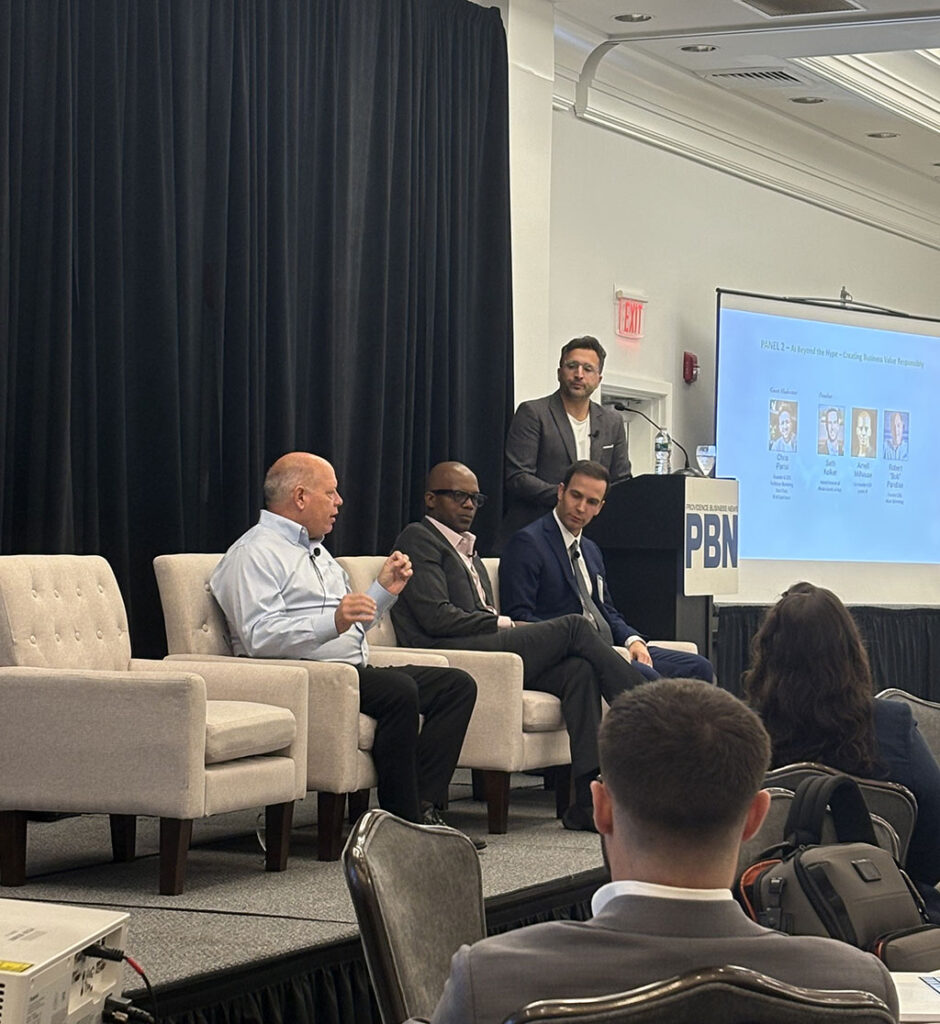
That tension was at the forefront of the Providence Business News’ 2026 Cybersecurity and AI summit. We were on the panel “AI Beyond the Hype: Creating Business Value Responsibly.”
The theme of the day was moving from risk to opportunity. The panel covered both sides. Here’s what came up, and what it means for your business.
What Does “AI Beyond the Hype” Actually Mean?
It means judging AI by what it does for your business, in NUMBERS, not by how exciting it sounds. Responsible AI is the AI you can control, you can measure, and one that you can trust to handle your data. If the AI plan you’re deploying can’t handle those 3 things, it’s not for you.
That’s a high bar, and most businesses aren’t there yet in figuring out how to go about doing this.
How Do You Keep AI In Check?
You keep AI in check by deciding up front what it is allowed to see and what it is allowed to do. The panel called this securing intent and agency.
Here’s what those two words mean in plain terms:
- Intent is the goal you give the AI. What job is it doing, and for whom?
- Agency is how much the AI can act on its own. Can it only suggest? Or can it send emails, move files, or change records without a person saying yes?
Newer AI tools can take real actions, not just write text. That’s powerful. It’s also risky. Picture an AI helper that can read your inbox and reply for you. Now picture someone tricking it with a hidden message inside an email. That’s not science fiction. It’s a real way attackers go after AI tools today.
So set limits before you turn anything on. Give each tool only the access it needs to do its one job. A person must be in the driver’s seat for anything that touches money, customer data, or contracts. And know which AI tools your team is using right now. If you don’t have rules written down yet, start with an AI usage policy.
Can You Point to a Number AI Has Changed?
If you can’t, you’re not alone. The panel put it bluntly: most people could not point to a single number that AI affects. Without a number, you can’t tell if AI is paying off or just costing you.
Big companies are stuck here too.
In fact, only thirty-seven percent of respondents attribute at least some EBIT impact to AI use (McKinsey).
The same survey found that the companies winning with AI do something simple. They are about twice as likely as others to have set ways to measure what their AI projects deliver. In other words, they decide what success looks like before they start.
You can do the same thing. Before you pay for any AI tool, write down one number you expect it to move. It might be:
- Hours your office staff spend on data entry each week
- Days it takes to send a quote or an invoice
- Calls or emails your team answers by hand
Check that number before you start. Check it again in 60 days. If it didn’t move, you’ve learned something cheap. If it did, you know where to invest next.
Why Do So Many Businesses Fail at AI?
Most businesses fail at AI because they skip the planning, not because the tools are bad. The panel named five gaps that trip people up again and again. Businesses don’t know:
- Where to start
- What to do first
- What to measure
- What success looks like
- Which tools fit their needs
Notice that only one of those five is about tools. The other four are about planning. That’s good news. Planning doesn’t cost much. It just takes time and someone who has done it before.
Think about it like adding a room to your house. You wouldn’t let a crew start swinging hammers before anyone drew a plan, set a budget, or decided what the room was for. AI is the same. The businesses that skip the plan end up with a pile of tools nobody uses and a monthly bill that keeps growing.
A good starting point is one painful, repeatable task. Pick something your team does every day that eats time and follows the same steps. That’s where AI tends to pay off first. If you want a guide for that first step, that’s exactly what our AI consulting services are built for.
How Has AI Changed the Cyber Threat Landscape?
AI has made attacks faster and harder to spot at the same time. The panel’s second half turned to security, and the message was clear: generative AI has made it very hard to tell what’s real and what’s fake.
A few years ago, a scam email was easy to catch. Bad spelling. Odd wording. A strange request. Now AI writes clean, friendly emails that sound just like your vendor or your boss. It can copy a voice on a phone call. It can make a fake video. Your team’s “gut check” isn’t enough anymore.
Speed is the other big change. The panel made the point that hackers no longer have to choose between fast and smart. They get both.
The average eCrime breakout time fell to just 29 minutes in 2025, with the fastest observed breakout occurring in only 27 seconds. (CrowdStrike)
Breakout time is how long it takes an attacker to move from the first computer they break into to the rest of your network. Half an hour on average. Less than half a minute at the fastest. If nobody is watching your systems around the clock, an attacker can be deep inside before anyone notices.
Why Is Offense Outpacing Defense?
Attackers are winning the speed race because they have no rules to follow and only one job. The panel said it well: threat actors don’t have the red tape we do. They don’t need approval from a board. They don’t have budgets to defend or meetings to sit through. Their whole purpose is to attack your business.
Now compare that to most companies. For most business owners, cybersecurity is an afterthought. It comes up after a scare, at insurance renewal, or when a client asks. For attackers, it’s all they think about.
That gap is why offense has pulled so far ahead of defense. It’s not that defenders are lazy. It’s that you’re running a business, and they’re running attacks full time.
You can’t match them hour for hour. But you can close the gap in a few smart ways:
- Make security someone’s job. If no one owns it, it gets done last.
- Watch your systems 24/7. With breakout times measured in minutes, overnight and weekend coverage matters.
- Train your team to slow down. Any request for money, passwords, or bank changes gets a second check by phone, using a number you already have.
- Test your backups. If attackers do get in, a clean, tested backup is what gets you running again.
If you’re not sure where your gaps are, a cybersecurity review is the fastest way to find out.
Key Takeaways
- Responsible AI passes three tests: you control it, you can measure it, and you trust it with your data.
- Pick one number you expect AI to move before you buy any tool, then check it again in 60 days.
- Four of the five reasons AI projects fail come down to planning, not technology.
- Attackers can now get through a network in minutes, so security that only runs from 9 to 5 leaves you open.
Get a Clear Plan for AI in Your Business
The panel’s biggest lesson was that AI only creates value when you control it and measure it. If you can’t point to a number AI has changed in your business yet, that’s the place to start. Book a free AI Strategy Review with Attain Technology. We’ll look at how your team uses AI today, find the one or two places it can pay off first, and show you how to do it safely. Schedule your free AI Strategy Review.
Why Choose Attain Technology
At Attain Technology, we’ve helped Rhode Island and Massachusetts businesses with their technology for nearly 20 years. We’re based in Providence, and we know the businesses we serve. Our team handles your IT and cybersecurity before problems start, explains things in plain English, and answers the phone with real people 24/7. When it comes to AI, we don’t sell hype. We help you find what works, set it up safely, and measure the results. If you want technology that works as hard as you do, we’d love to talk.
FAQ
What is responsible AI for a small business?
Responsible AI is AI that you control, can measure, and trust with your data. For a small business in Rhode Island, that means a few simple rules. Limit what each tool can see and do. Keep a person in the loop on important tasks. Track one number to prove it works.
How do I measure AI ROI for my business?
Pick one number before you buy any AI tool. It could be hours spent on data entry, days to send a quote, or emails answered by hand. Check that number before you start, then again in 60 days. If it moved, AI is paying off. If not, you learned something cheap.
What is breakout time in cybersecurity?
Breakout time is how long it takes an attacker to move from the first computer they break into to the rest of your network. In 2025, the average was just 29 minutes, and the fastest was 27 seconds. That is why businesses in Providence and across Rhode Island need 24/7 monitoring.
Why do so many AI projects fail?
Most AI projects fail because businesses skip the planning, not because the tools are bad. They don’t know where to start, what to do first, what to measure, what success looks like, or which tools fit their needs. Four of those five gaps are about planning, which is the easiest part to fix.
Where can Rhode Island businesses get help with AI strategy?
Attain Technology in Providence helps Rhode Island and Massachusetts businesses build AI plans that are safe and easy to measure. Our free AI Strategy Review looks at how your team uses AI today. We find where it can pay off first. Then we show you how to get there without putting your data at risk.
