
Wireless signal strength heatmap layout

Wireless Network Heat Mapping & Site Surveys in Boston, Worcester & Providence

Most companies don’t really have a Wi-Fi problem… they have a guessing problem. Routers shoved into corners. Extra access points added ‘just in case.’ And then—dead zones, slow speeds, and endless complaints. We don’t guess. We map. With our professional wireless network heat mapping and site survey services in Boston, Worcester, and Providence, we show you exactly how your Wi-Fi is performing—so you get coverage that works everywhere you need it.

Stress-Free Wi-Fi Starts Here →

Wireless Network Site Surveys & Consulting

Here’s what we deliver:

Wireless Network Heat Mapping Services. Professional on-site surveys to find weak spots, dead zones, and interference.
Wireless Network Site Survey Company. Accurate designs that place access points in the right spots—before you buy anything.
Wireless Network Consulting. Local expertise to fix Wi-Fi headaches in offices, warehouses, and manufacturing plants.
Wireless Network Site Survey Services. Plans tailored for your devices, your people, and your growth.”

blue bg tech

Why Choose Attain Technology For Their Wi-Fi Heatmapping

Reliable Wi-Fi keeps your business connected and productive. Attain Technology delivers wireless heatmapping and optimization services that show exactly how your network performs, not just what’s promised. We use enterprise-grade tools trusted by airports, hospitals, and Fortune 500 companies to identify weak spots, reduce unnecessary equipment costs, and create a network that performs where it matters most. Whether you’re managing a construction site, manufacturing floor, or professional office, our team designs wireless systems that deliver consistent coverage, dependable speed, and proven results. Based in New England, we support businesses across Boston, Providence, Hartford, Worcester, and surrounding areas with expert local service you can trust.

Book my Free Wi-Fi Checkup

What You See in a Professional Wi-Fi Heatmap

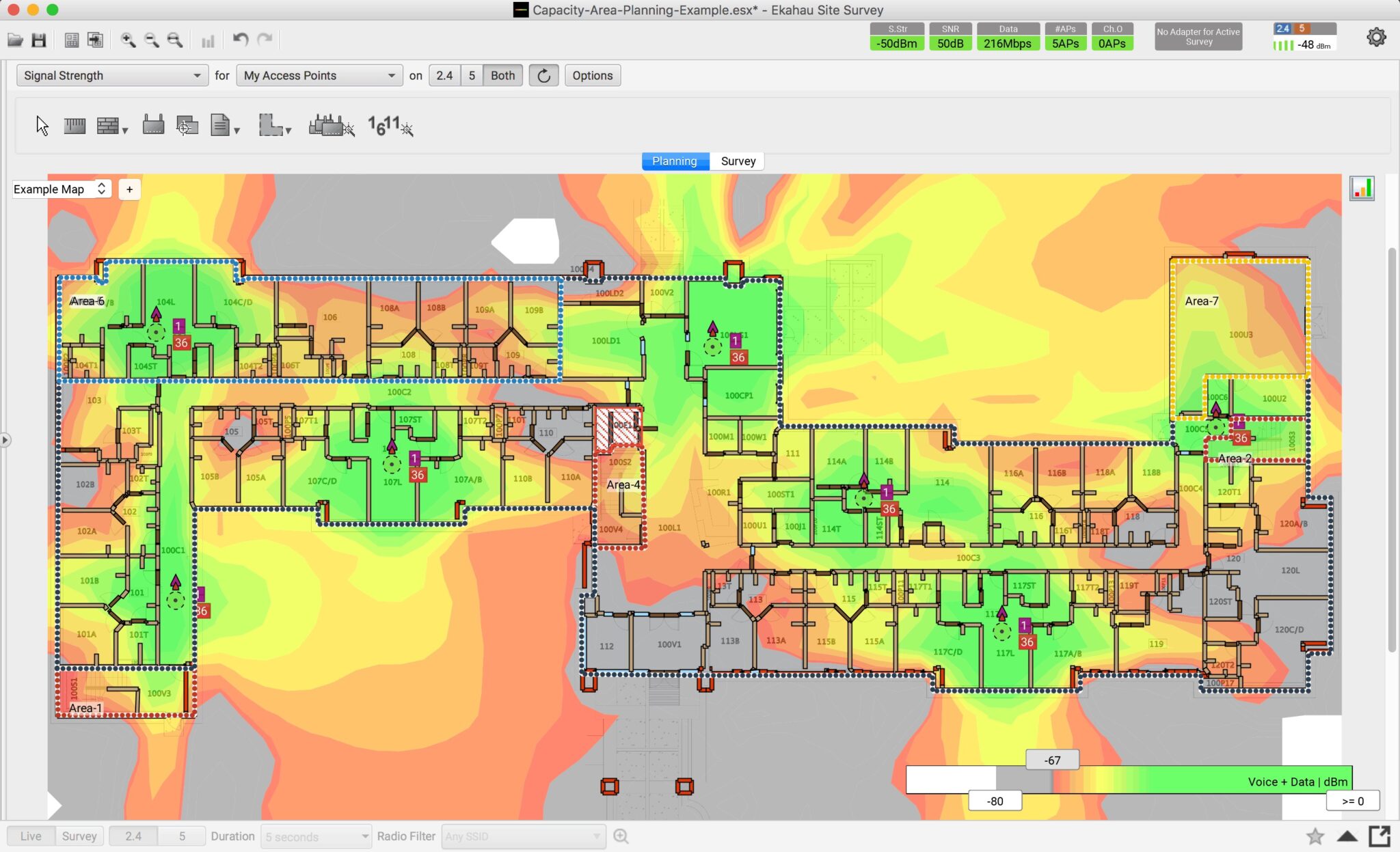
Our Wi-Fi heatmaps make the invisible visible. They show you where your signal is strong, where it’s weak, and what’s getting in the way. Here’s what we measure:”

  • Signal Strength (dBm): See where Wi-Fi is strong and where it drops off.
  • Noise (SNR): Find out if background “chatter” is slowing you down.
  • Channel Coverage: Shows which Wi-Fi channel is working in each spot.
  • Throughput (Max): How fast your Wi-Fi could go.
  • Data Rate: How fast your devices really connect.
  • Packet Loss: Where data gets lost, causing freezes and glitches.
  • Channel Overlap: Too many devices crowding the same lane.
  • Interference/Noise: Other signals fighting with your Wi-Fi.
  • Difference in Interference: Compare main vs. backup coverage.
  • Capacity Health: Can your Wi-Fi handle everyone at once?
  • Network Health: Overall grade for your network.
  • Associated Access Point: Which access point devices connect to.
  • Number of APs: How many access points your devices can “hear.”
  • Difference in Number of APs: Compare main vs. backup coverage.
  • Difference in Signal Strength: Spot weak areas between access points.

This is how we take the guesswork out of Wi-Fi—and guarantee coverage that works.

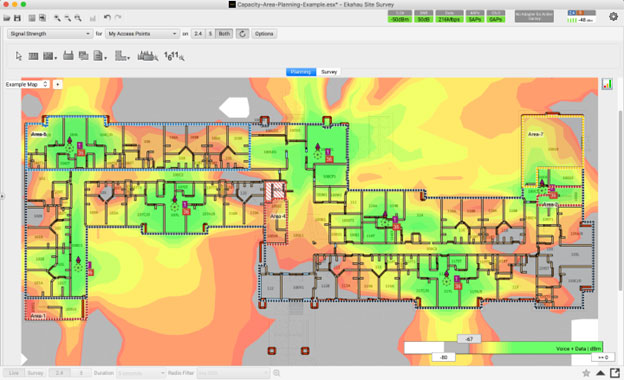
Wi-Fi heatmap visualization from a professional wireless site survey.

Frequently Asked Questions

Wireless network heat mapping is a diagnostic process that uses specialized software and hardware to create a visual map of Wi-Fi signal strength and coverage throughout your office or commercial space. The resulting ‘heat map’ uses color gradients—typically green for strong signal and red for weak or no signal—to show exactly where your wireless network performs well and where dead zones, interference, or signal degradation exist.

It transforms what’s normally an invisible, frustrating guessing game (‘Why is the Wi-Fi slow in the conference room?’) into a clear, data-driven picture that guides targeted improvements.

Wi-Fi performance is affected by many factors beyond just your internet speed.

  • Physical obstructions like walls, floors, metal structures, and even glass can weaken or block signals. Interference from neighboring wireless networks, Bluetooth devices, microwaves, and other electronics can degrade performance.
  • Access points that are poorly placed, too few in number, or incorrectly configured create coverage gaps. Older access points may not support modern Wi-Fi standards that enable faster speeds.
  • And in multi-tenant buildings common in Providence, Boston, and other urban areas in Rhode Island and Eastern Massachusetts, the sheer density of competing wireless signals can cause congestion.

A heat mapping survey identifies which of these factors are affecting your specific environment.

The terms are related and sometimes used interchangeably, but there’s a distinction.

  • A Wi-Fi heat map is the visual output—the color-coded map showing signal strength across your space.
  • A wireless site survey is the broader process that produces the heat map and may also include analysis of channel utilization, interference sources, client device density, access point performance, and recommendations for improvement.
  • A predictive site survey can even model Wi-Fi performance in a space before any equipment is installed, using floor plans and building materials data.

When a provider offers wireless network heat mapping, they’re typically performing a full site survey that results in actionable recommendations, not just a pretty picture.

A technician visits your location with specialized survey equipment—typically a laptop running professional Wi-Fi analysis software and a calibrated wireless adapter. They walk through your entire space, taking measurements at regular intervals across every area where wireless connectivity is needed.

The software records signal strength, noise levels, channel utilization, and data throughput at each measurement point and compiles this data into a visual heat map overlaid on your floor plan.

The process typically takes a few hours for a standard office environment. The result is a detailed report showing exactly where coverage is strong, where it’s weak, what’s causing the problems, and what changes are recommended.

There are several situations where a heat mapping survey is especially valuable:

  • When you’re moving into a new office and need to plan access point placement from scratch
  • When employees are consistently complaining about Wi-Fi speed or connectivity in certain areas
  • When you’re expanding your workspace or adding more wireless devices
  • After a renovation that changed your floor layout or building materials
  • When deploying VoIP phones or other systems that are sensitive to wireless performance
  • When you simply don’t know why your Wi-Fi is unreliable and want data instead of guesswork.

Proactively heat mapping your space before problems become chronic saves time and money compared to reactive troubleshooting.

Yes—and it can also reveal that you need more than you currently have.

Many businesses either over-deploy access points (wasting money and creating co-channel interference that actually degrades performance) or under-deploy them (leaving dead zones that frustrate employees). A heat map shows you the optimal number and placement of access points for your specific environment, eliminating the guesswork.

In some cases, repositioning existing access points based on heat map data can dramatically improve performance without purchasing any new equipment. The goal is right-sized coverage: strong, consistent Wi-Fi everywhere it’s needed, with no waste.

Yes. Because Attain Technology provides both wireless network heat mapping and full structured cabling and network infrastructure services, the team that diagnoses your wireless issues is the same team that can implement the solution.

This means there’s no gap between the assessment and the fix—no need to find a separate vendor to install access points, run cable to new locations, or configure your wireless controller.

The heat map recommendations feed directly into a project plan that includes equipment selection, cabling, installation, configuration, and post-installation testing to verify that the improvements achieved the intended coverage goals.

Technology design

Free Wi-Fi Checkup Offer

Free Wi-Fi Checkup Call
Share your frustrations—we’ll tell you if a site survey is the right move.

Let’s Fix Your Wi-Fi

Stop guessing. Start knowing.
Whether you’re in Boston, Worcester, or Providence, our wireless
network site survey services will deliver Wi-Fi that just works.

Call 401-944-1050

Stress-Free Wi-Fi Starts Here →