

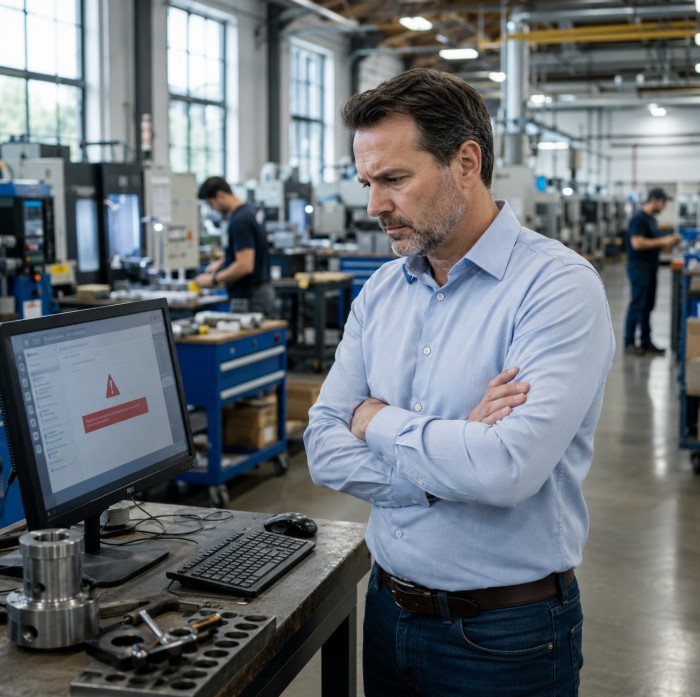
Picture this. Your team shows up Monday morning ready to run production. A system is crawling. Someone calls your IT provider. An hour goes by. Then two. By the time anything gets fixed, you have lost a half day of output and your floor supervisor is fielding angry questions you do not have answers to.
That scenario plays out more often than it should at manufacturing shops across Rhode Island and Massachusetts. The hard part is that most owners do not realize how much their IT situation is holding them back until the pain is already serious. In fact, it’s estimated that an hour of tech downtime can cost anywhere from $5,000 for smaller job shops to $260,000 an hour for larger ones… still think a reliable IT provider is “too expensive”?
If you have been wondering whether your current IT setup is still doing the job, here are seven signs that it is time for a change.
Sign 1: Your IT Provider Has No Plan for AI
This is the sign that matters most right now, and it is the many manufacturing leaders are still trying to figure out.
AI is no longer a future concept. It is already on your competitors’ radar, and in many cases, on their shop floors. According to Rootstock Software’s 2025 State of AI in Manufacturing Survey, over 77% of manufacturers have now implemented AI in some form, up from 70% the year before. That number is only going up.
Your IT provider’s job is not just to keep the lights on. It is to help you move the business forward. If your current IT partner has never brought up AI, cannot explain how to use it safely, and has no roadmap for helping you explore where it fits in your operations, that is a problem. You are not asking for a technical deep dive. You are asking for a trusted advisor who can tell you where AI actually helps a shop like yours, how to start small, and how to make sure your data stays protected in the process.
A good IT partner does not leave you guessing on this. If yours does, that is a clear sign it is time to look elsewhere.
Sign 2: Downtime Keeps Happening
Downtime is the most expensive word in manufacturing. When a line stops, everything stops. And if it is happening more than once or twice a year without a clear resolution, your IT setup is not doing its job.
The definition of unplanned downtime is straightforward: any time your systems, network, or equipment go offline unexpectedly during a production window. What it costs is not straightforward at all. For small and mid-sized manufacturers, even a few hours of lost production can erase an entire week of margin.
If your IT provider’s answer to downtime is to show up after the fact and fix what broke, you are stuck in a reactive cycle. Proactive IT management means problems are caught and addressed before they stop production. If that is not what you are getting in Providence, Worcester, or anywhere else in southern New England, your current setup is costing you more than you realize.
Sign 3: You Do Not Know What Is in Your Network
If someone asked you right now what devices are connected to your network, what software is running on them, and whether everything is patched and up to date, could you answer? If the honest answer is no, or “I think so,” that is a warning sign.
Manufacturers running fabrication shops, assembly lines, and mixed office and floor environments often have more devices connected to their networks than anyone has tracked. Old workstations running outdated software. Personal devices that got connected and never got removed. Systems that were added during a growth push and never fully documented.
This is not a small problem. What you cannot see, you cannot protect. And if your IT provider cannot give you a clear, current picture of your environment, they are not in a position to manage or secure it properly. A good IT partner knows your network better than you do, not the other way around.
Sign 4: Your Cybersecurity Isn’t Keeping Up with AI-Powered Attacks
Manufacturing businesses in Rhode Island and Massachusetts are targets. That is not a scare tactic. It is a fact that cybercriminals know smaller manufacturers often have weaker protections and valuable operational data. With AI powered attacks, phishing emails are becoming more convincing, code is re-writing itself to better infiltrate your cyber defense, and hackers can send more attacks than ever without lifting a finger.
The real question is, does your cybersecurity stack up to defend these modern threats?
If your current cybersecurity posture looks like this, it is time to take it seriously:
- No regular security training for your team
- No multi-factor authentication on email and key systems
- No clear plan for what happens if you get hit
- Backups that exist but have never been tested for recovery
If your IT provider is not actively managing this new threat, you are exposed. The question is not whether you will be targeted. It is whether you will be ready when it happens.
Sign 5: Your Backups Have Never Been Tested
Lots of manufacturing businesses have backups. Far fewer have ever tested whether those backups actually work when you need them.
A backup that has never been restored is not really a backup. It is a hope. If your business got hit with ransomware tomorrow morning and your IT provider said, “let’s restore from backup,” how confident are you that the restore would work? How long would it take? Would you lose a day of data? A week?
If you do not know the answers to those questions, you are not as protected as you think. A reliable IT partner tests restores on a regular schedule, documents recovery times, and makes sure you can get back to production fast when something goes wrong. If that is not happening at your shop, that needs to change.
Sign 6: Your IT Provider Is Hard to Reach
This one is simple, and it matters more than people admit. When something breaks at 6 AM before first shift, you need a real person who picks up the phone. Not a ticketing system. Not a callback in four hours. Not an email.
If you have had to wait a full business day to get a response to an urgent issue, your IT provider is not built for manufacturing. Your business does not run on a 9-to-5 schedule, and your IT support should not either.
Slow response times are one of the top reasons manufacturing businesses in New England start looking for a new IT partner. It is also one of the clearest signs that your current provider is not the right fit.
Sign 7: Your Systems Are Not Talking to Each Other
If your ERP, your shop floor systems, your file storage, and your accounting platform each live in their own separate world, you are losing time and creating errors every single day.
Disconnected systems are one of the most common sources of operational friction in manufacturing. Your team compensates with manual workarounds. Someone re-enters data from one system into another. A number gets wrong somewhere in the middle. A manager cannot pull the real-time information they need because it is spread across three platforms that do not connect.
A good IT partner helps you understand where your systems have gaps, which integrations make sense, and how to build toward a connected, visible operation without disrupting what is already working. If your current IT provider has never raised this conversation, they are missing the bigger picture.
Ready to See Where You Stand?
If any of these signs feel familiar, it is worth having an honest conversation about your current IT situation. At Attain Technology, we work with manufacturers across Rhode Island and Massachusetts every day. We know the pressures you are managing. We also know what good IT looks like for a shop like yours.
Reach out to us today and start getting the answers you need!
Why Choose Attain Technology
Attain Technology has supported New England manufacturers for nearly 20 years. We understand the pressure of keeping production moving, managing tight margins, and staying ahead of an IT landscape that keeps changing. Our proactive approach means we are watching your systems before problems happen, not reacting after the damage is done. When something does go wrong, you get a real person on the phone, fast. And when it comes to bigger questions like AI readiness and cybersecurity, we give you a straight answer and a practical plan. If you are ready for an IT partner who takes ownership and shows up when it matters, we would love to talk.
Frequently Asked Questions
What are the signs a manufacturing business needs a new IT provider?
The biggest signs include repeated downtime with no real fix, slow or hard-to-reach support, untested backups, weak cybersecurity, and an IT partner who has no guidance on AI. If your systems are disconnected and your provider does not know your network well, those are also red flags worth taking seriously for any Rhode Island or Massachusetts manufacturer.
How does IT downtime affect manufacturing businesses in Rhode Island?
Downtime stops production, idles your workforce, and can push back deliveries and customer commitments. For small and mid-sized manufacturers in Rhode Island and Massachusetts, even a few hours of unexpected downtime can wipe out a week of margin. Proactive IT management is the most reliable way to reduce how often it happens and how long it lasts.
What does good manufacturing IT support look like?
Good manufacturing IT support is proactive, not reactive. It means regular monitoring, fast response when something breaks, tested backups, active cybersecurity management, and a partner who understands your operation. For manufacturers in Providence, Worcester, or Hartford, it also means local knowledge and someone you can actually get on the phone when production is at risk.
How should a manufacturing business prepare for AI?
Start by making sure your IT foundation is solid. AI works best when your systems are connected, your data is clean, and your network is secure. Your IT provider should be able to walk you through where AI can help your specific operation and how to start safely. Most manufacturers do not need a large investment to begin. They need the right guidance and a low-risk starting point.
What is unplanned downtime in manufacturing and why does it matter?
Unplanned downtime is any time your production systems, machines, or network go offline without warning. It matters because it stops output immediately and creates costs that go well beyond the repair itself. Idle labor, missed shipments, and recovery time all add up fast. U.S. manufacturers lose an estimated $50 billion per year to unplanned downtime, making prevention a top priority for any shop focused on profitability.
