
AI governance is how your business sets clear rules for using AI safely, wisely, and with control. For Rhode Island and Massachusetts businesses, it helps you use tools like ChatGPT, Microsoft Copilot, and other AI apps without putting private data, client trust, or daily work at risk.
Picture this. Someone on your team uses an AI tool to write a client email, summarize a contract, or sort a spreadsheet. It saves time. But they may also paste in customer data, employee records, pricing, or private company notes without knowing the risk.
63% of organizations studied lacked AI governance policies to manage AI or prevent the spread of shadow AI. (IBM Cost of Data Breach Report 2025)
That is why AI governance matters now. It is not just for large firms in Boston or global tech companies. It matters for local business owners in Providence, Worcester, Framingham, Hartford, and across southern New England.
What is AI governance?
AI governance is a set of rules, roles, and checks that guide how your business uses artificial intelligence. It helps your team know what AI tools they can use, what data they can enter, who approves new tools, and how results should be reviewed.
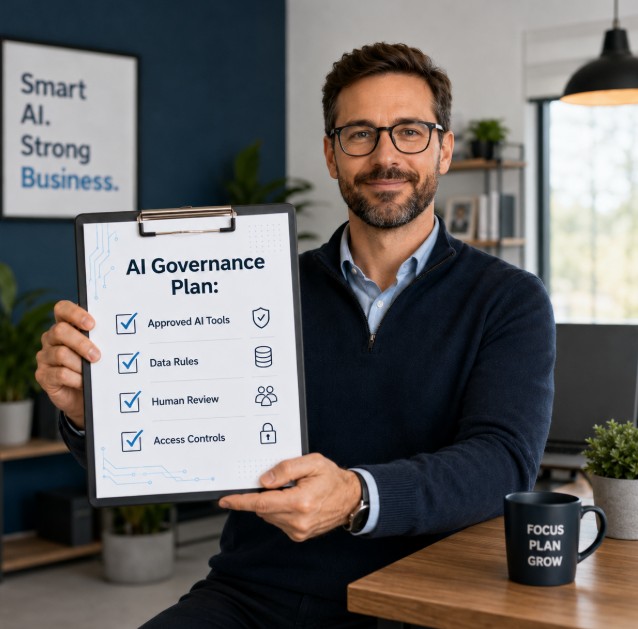
A simple AI governance plan answers basic questions:
- Which AI tools are approved?
- What data should never go into AI tools?
- Who reviews AI output before it is used?
- How do we protect customer and employee data?
- Who owns AI decisions inside the company?
That may sound formal, but it does not have to be complex. For many Rhode Island and Massachusetts small businesses, AI governance starts with one page of clear rules. The goal is not to slow your team down. The goal is to help them use AI with confidence.
Why does AI governance matter for local businesses?
AI governance matters because your team may already be using AI, even if leadership has not approved it. This is often called shadow AI.
Shadow AI means employees use AI tools without review, approval, or security checks. They may do it with good intent. They want to save time. They want a faster answer. They want help with writing, research, notes, reports, or customer service.
The risk comes from what happens next. A team member may paste sensitive data into a public AI tool. Another may rely on an AI answer that sounds right but is wrong. Someone else may install a browser add-on or AI app that has weak security.
One in five studied organizations experienced breaches linked to shadow AI, and these incidents added as much as USD 670,000 to the average breach cost. (IBM Cost of Data Breach Report 2025).
What AI risks should Rhode Island and Massachusetts businesses watch?
The biggest AI risks are data exposure, wrong answers, unclear ownership, and weak access control. Most businesses do not need to fear AI itself. They need to fear AI use without rules.
Here are the risks that show up most often:
- Employees enter private client data into public tools.
- AI creates wrong answers that no one checks.
- Staff use tools that leadership does not know about.
- Vendors add AI features without clear notice.
- AI output creates bias, privacy, or compliance concerns.
- No one knows who is responsible when AI causes a problem.
This matters in every part of your business. AI may touch sales, finance, HR, operations, customer service, marketing, and IT. If one team uses AI well but another uses it loosely, risk still spreads.
Among organizations that reported AI-related breaches, 97% lacked proper AI access controls (IBM Cost of a Data Breach).
That is a clear warning. AI governance should include access control. Not every person needs access to every AI tool. Not every tool should connect to email, files, customer records, or financial systems.
How does AI governance help your team use AI better?
AI governance helps your team move faster because it removes guesswork. When people know the rules, they do not need to wonder what is safe.
Without governance, employees may hide AI use or avoid it fully. Both create problems. Hidden use creates risk. Full avoidance may leave useful gains on the table.
With governance, your team gets a clear path:
- Use approved tools.
- Keep private data out of unsafe tools.
- Check AI output before sending it.
- Ask for approval before adding new AI apps.
- Report mistakes or concerns early.
This gives your business a safer way to test AI. You can start with low-risk use cases, such as drafting internal notes, summarizing public information, creating first drafts, or helping with meeting follow-ups.
Then you can move into higher-value work once controls are in place. That may include help desk support, sales follow-up, document search, workflow automation, or data review.
The key is control. AI should support your team, not create a new set of hidden risks.
What should an AI governance policy include?
An AI governance policy should explain what your team can use, what they cannot use, and who makes the call. It should be simple enough that people will read it.
A strong starter policy should include:
- Approved AI tools
- Blocked AI tools
- Data that must never be entered
- Rules for client, employee, and financial data
- Review steps for AI output
- Vendor approval rules
- Security and access rules
- A person or team responsible for AI questions
- Training for employees
- A review schedule
For example, your policy may say: “Do not paste customer names, Social Security numbers, health data, financial records, contracts, passwords, source code, or private company data into public AI tools.”
That one rule can prevent a lot of harm.
Your policy should also explain that AI output must be checked by a person. AI can sound confident and still be wrong. A business in Boston should not send a client-facing answer, quote, policy, or legal summary just because an AI tool wrote it.
What is happening with AI in Rhode Island and Massachusetts?
Rhode Island and Massachusetts are already paying attention to AI, so local businesses should pay attention too. State action does not mean every business has a new rule today, but it does show where the market is moving.
Massachusetts created an Artificial Intelligence Strategic Task Force to study AI and generative AI and its impact on state government, private businesses, higher education, and residents.
Rhode Island created its first AI Task Force and a Center of Excellence for AI and Data within state government.
This matters for business leaders because AI trust is becoming part of normal operations. Clients, partners, insurers, banks, and vendors may start asking how your business uses AI. They may want to know how you protect data. They may also ask whether your team has clear AI rules.
A simple AI governance plan helps you answer those questions before they become urgent.
Call to Action
If your team is using AI but you do not have clear rules yet, now is the right time to act. Attain Technology can help you review your current AI use, spot risk, and create a simple AI governance plan that fits your business.
Schedule an AI Governance Readiness Conversation with Attain Technology Today.
Why Choose Attain Technology
At Attain Technology, we help New England businesses adopt AI the right way, with proper guidance and governance. From starting you off on your first AI workflow to scaling AI across your business, we’ll guide you along every step to ensure your team is properly supported and trained on AI.
FAQ
What is AI governance for small businesses?
AI governance is a simple set of rules for safe AI use. It tells your team which tools are allowed, what data is off limits, and who reviews AI output. For small businesses in Rhode Island and Massachusetts, it helps reduce risk while still allowing useful AI work.
Why do Massachusetts businesses need AI governance?
Massachusetts businesses need AI governance because employees may already use AI tools with company data. A clear policy helps protect client records, employee data, and private business information. It also prepares your company for future questions from clients, insurers, vendors, and regulators.
How does AI governance reduce business risk?
AI governance reduces risk by setting clear rules before mistakes happen. It helps stop private data from being entered into unsafe tools, limits access to approved users, and makes sure people review AI answers. This lowers the chance of bad output, data leaks, and poor decisions.
What should Rhode Island businesses include in an AI policy?
Rhode Island businesses should include approved tools, blocked tools, data rules, review steps, access controls, and vendor approval rules. The policy should also name the person responsible for AI questions. Keep it short and clear so your team can follow it every day.
Can AI governance help my team use AI better?
Yes, AI governance can help your team use AI better because it removes confusion. Employees know what is allowed, what is unsafe, and when to ask for help. That makes AI easier to use in daily work while keeping your business data more secure.
