

How smart companies are using Task Agents and Organizing Agents to cut AI costs by up to 80% while getting dramatically better results
Here is a number that should get your attention.
The cost of a single AI token has dropped 99.7% since 2023. Per-token prices are lower today than they have ever been. And yet, the average enterprise AI bill grew 36% between 2024 and 2025. The share of companies spending more than $100,000 per month on AI more than doubled in the same window.
Let that sink in. Prices crashed. Bills went up.
This is not a billing error. It is the predictable result of what happens when businesses adopt AI tools without building AI infrastructure. They run every task through the same expensive frontier model. They let agents loop through the same context repeatedly. They burn premium tokens on work that a basic model could handle in its sleep. The tab compounds until someone in finance asks a very uncomfortable question.
This article is about solving that problem before it starts, or fixing it if it already has.
More importantly, it is about the strategic opportunity that problem creates. Because the businesses that build their AI infrastructure correctly right now will have a structural cost and capability advantage over every competitor still figuring it out. That gap is already opening. The question is which side of it you want to be on.
Bottom line: The companies that win with AI in the next three years will not be the ones using the most powerful model. They will be the ones using the right model for every task, with an architecture designed to make that happen automatically.
What You Are Actually Paying For: The Token Economy, Explained
Before you can make intelligent decisions about AI infrastructure, you need to understand its fundamental unit of cost.
A token is not a word. It is not a character. It is a subword unit, roughly four English characters on average. A 1,000-word document consumes approximately 1,300 to 1,500 tokens depending on vocabulary and structure. Every prompt you send, every response the model generates, every tool call, every round-trip between agents: all of it is measured in tokens, and all of it appears on your invoice.
Here is where it gets important for business owners: output tokens cost three to five times more than input tokens. The model charges more to generate a response than it does to receive your prompt. That means a long, wordy AI response on a simple task is not just slightly wasteful. It is actively expensive in a way that compounds across thousands of daily transactions.
And when you introduce agents, which we will cover in detail shortly, the token math gets extreme. Agentic workflows multiply token usage 50 to 500 times per task compared to a simple prompt-and-response exchange. A single complex agent session can burn 1 to 3.5 million tokens. At frontier model prices, that is real money.
Here is the current pricing landscape as of mid-2026, so you have a real benchmark:
- Claude Opus 4.8 (Anthropic): $5.00 per million input / $25.00 per million output tokens. Best for complex reasoning and long-horizon tasks.
- Claude Sonnet 4.6 (Anthropic): $3.00 per million input / $15.00 per million output tokens. The production workhorse for coding, analysis, and instruction-following.
- GPT-4o (OpenAI): $2.50 per million input / $10.00 per million output tokens. Strong general-purpose model.
- Gemini 2.5 Flash (Google): $0.30 per million input / $2.50 per million output tokens. Exceptional value for high-volume tasks.
- DeepSeek V3: $0.27 per million input / $1.10 per million output tokens. Scores 80.6% on real-world software engineering benchmarks at a fraction of frontier cost.
- Claude Haiku 4.5 (Anthropic): Sub-$1.00 input per million tokens. Built for speed and volume.
For a live, continuously updated comparison across all major providers, AI Pricing Guru tracks 123 models across 12 providers and updates daily.
The strategic insight that pricing table reveals is simple but profound. There is a 100x price gap between the cheapest capable model and the most expensive frontier model. If you are routing every task through the top of that range, you are leaving enormous money on the table for no good reason.
One more cost reality that most teams discover too late: the token bill is only part of your actual AI cost. Research consistently shows that 72% of production AI spend sits outside the model invoice, in orchestration overhead, retrieval systems, monitoring, retry logic, idle capacity, and engineering time. A realistic enterprise AI budget is approximately 1.7 times your base token estimate once you account for everything around the model. Build that into your planning from day one.
Reading the Leaderboards: Not Every Model Is Built for Your Job
The most expensive model is not the best model for most tasks. In 2026, AI has entered an era of specialization. No single model dominates every category. The right model depends entirely on what you are asking it to do.
Three resources give you an honest, data-driven answer to that question.
Arena AI Leaderboard
arena.ai/leaderboard is crowd-sourced human preference ranking. Real users vote on which model produces the better response without knowing which model they are evaluating. This is where you go to understand how models actually feel to use, not just how they score on controlled benchmarks.
Vellum LLM Leaderboard
vellum.ai/llm-leaderboard is benchmark-driven performance tracking across graduate-level science reasoning, advanced mathematics, real-world software engineering, and instruction following. Use this to match a specific model to a specific task type with data behind it.
LLM Stats
llm-stats.com provides filterable rankings across 300-plus models sortable by intelligence, speed, cost, provider, license, and context window.
Here is what these leaderboards show for the major task categories most businesses care about:
- Coding and software development: Claude leads SWE-bench and powers the two most widely adopted AI coding editors in production use today.
- Deep research and multi-step reasoning: Gemini 3.1 Pro leads pure benchmark performance. Claude closes the gap when tool use and agentic workflows are involved.
- Long-form writing and document generation: Claude produces the most natural prose and supports 128,000-token outputs in a single pass.
- High-volume, fast-turnaround processing: Gemini Flash and Claude Haiku handle classification, summarization, and extraction at a fraction of frontier costs.
- Cost-efficient general reasoning: DeepSeek V4 scores 80.6% on SWE-bench Verified at $0.87 per million output tokens. The last 7 to 15 points of benchmark performance cost 20 to 50 times more per token.
The strategic conclusion: if your AI infrastructure routes every task through the same model regardless of what that task requires, you are overpaying for most of your work and possibly underperforming on the tasks where model selection actually matters.
The Architecture That Changes the Math: Task Agents and Organizing Agents
This is the section that pays for the time you spent reading everything above.
The businesses winning the AI cost and capability game right now are not the ones with the most powerful model. They are the ones that have built the most intelligent routing architecture. The difference between a mature AI infrastructure and an immature one is not which LLMs you have access to. It is whether you have an intelligent system deciding which LLM handles each task.
The Organizing Agent: Your AI Operations Manager
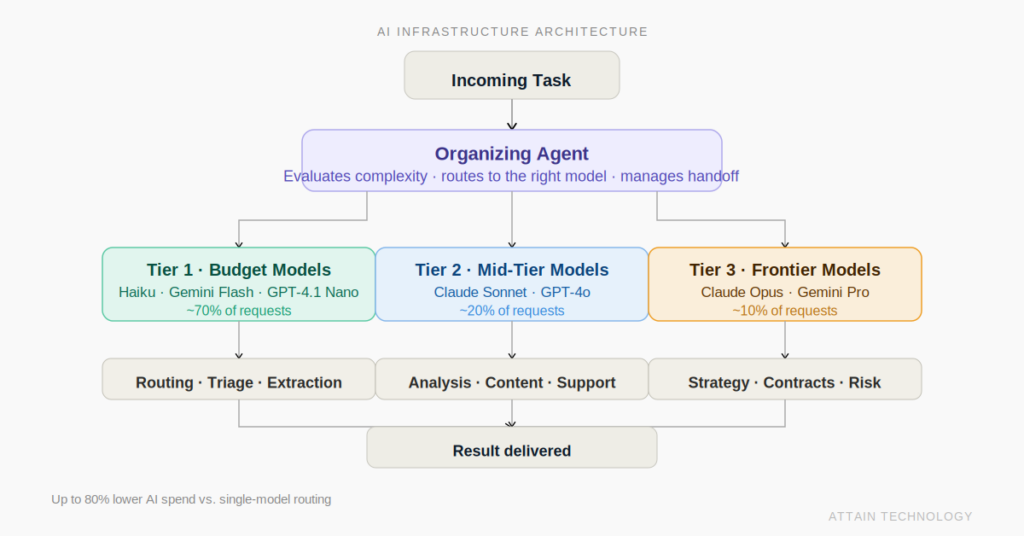
An Organizing Agent does not do the work. It decides who does the work.
Think of it as the operations manager of your AI infrastructure. When a task comes in, the Organizing Agent evaluates it: What type of request is this? How complex is it? What is the risk tolerance? Based on those criteria, it routes the task to the appropriate Task Agent running on the appropriate model, manages the handoff, tracks the result, and handles escalation if the initial routing does not produce an acceptable output.
A well-designed Organizing Agent applies tiered routing logic:
- Tier 1 (approximately 70% of requests): Budget models like Claude Haiku, GPT-4.1 Nano, or Gemini Flash. These handle classification, ticket routing, data extraction, summarization, and routine customer interactions.
- Tier 2 (approximately 20% of requests): Mid-tier models like Claude Sonnet 4.6 or GPT-4o. These handle tasks requiring stronger reasoning or more nuanced language.
- Tier 3 (approximately 10% of requests): Frontier models like Claude Opus 4.8. Reserved for genuinely complex tasks where the difference in output quality justifies the difference in cost.
That routing logic alone, implemented consistently, can cut your AI spend by 60 to 80% without reducing output quality on the tasks that matter.
Real math: If 70% of your requests shift from a $15/million output frontier model to a $2.50/million output budget model, your effective blended rate drops by roughly 65% on those transactions. At 10 million output tokens per month, that is a $125,000 annual reduction.
Task Agents: Purpose-Built for One Job
A Task Agent is built to do one specific thing extremely well. A billing agent handles billing questions. A knowledge agent retrieves documentation. A compliance agent checks outputs against policy. A content agent drafts marketing materials. A security monitoring agent reviews alerts.
Each agent is sized to its workload. The billing agent does not need frontier reasoning capability. It needs reliable, consistent, fast responses. Route it to a budget model. The compliance agent reviewing contracts needs precision. Route it to Tier 3.
Well-designed multi-agent systems complete tasks three to five times faster than single-agent approaches, at 90% lower costs, with 40 to 60% better accuracy. The reason is structural: specialization produces better outputs, and intelligent routing eliminates waste.
The Orchestration Layer: What Holds It Together
Orchestration covers coordinating agent handoffs, managing shared context and memory, standardizing tool integration, tracking state across multi-step workflows, handling failures and retries intelligently, and maintaining observability across the entire system.
Without proper orchestration, even well-designed agents duplicate work, produce inconsistent outputs, and create security blind spots. A recent MIT analysis found that 95% of AI initiatives fail to reach production not because the models lacked capability, but because the systems lacked architectural robustness, governance structure, and integration depth.
Five Cost Controls That Belong in Every AI Infrastructure
Once you have the architecture right, these five controls lock in the savings.
1. Prompt Caching
Anthropic offers up to 90% savings on cached input tokens. For agents that repeatedly pass the same context, the savings compound quickly. This is the most underused cost control in organizations new to agentic deployment.
2. Batch Processing
Batch API pricing delivers a 50% discount by running non-time-sensitive workloads asynchronously over a 24-hour window. Half price, same quality. The only cost is a few hours of latency on tasks where that latency does not matter.
3. Budget Circuit Breakers
Set hard spending limits per agent and per workflow. An unoptimized agent that enters a retry loop on a failing tool can generate a month of expected spend in a few hours. Circuit breakers are not optional in a production AI environment. They are table stakes.
4. Output Length Controls
Output tokens cost three to five times more than input tokens. Tight system prompts that specify concise output formats and define structured response schemas reduce output token spend significantly on high-volume workflows.
5. Self-Hosting Evaluation
At approximately 500,000 or more tokens per day sustained, self-hosting open-weight models like DeepSeek or Llama begins to break even against hosted API pricing. For most small and mid-size businesses, pay-per-token APIs remain the practical choice.
The Geographic Question: Does Location Matter for AI Infrastructure?
For businesses in markets like Southern New England and the greater Boston corridor, serving clients in construction, manufacturing, healthcare, and professional services, the regional context shapes three concrete infrastructure decisions.
- Data residency and compliance: Certain regulated industries require that data processed by AI systems remain within specific geographic or jurisdictional boundaries. Not all model providers offer data residency options. That requirement should be part of your vendor evaluation.
- Industry-specific model performance: Construction and manufacturing workflows have specific vocabulary and context requirements. The leaderboards tell you general capability. Your testing with domain-specific content tells you actual performance.
- Response time and latency: US-based inference endpoints from major providers generally deliver sub-200-millisecond response times. If you are deploying real-time voice agents or high-frequency automation, latency becomes a specific engineering consideration.
The right infrastructure for a manufacturing company in Rhode Island and the right infrastructure for a software startup in San Francisco are not the same thing.
What This Means for Your Business Right Now
The window to build a meaningful AI infrastructure advantage is open right now. It will not stay open indefinitely. The businesses that architect this correctly over the next 12 to 18 months will have cost structures, response capabilities, and client experience advantages that will be genuinely difficult for slower-moving competitors to replicate.
The most common mistake we see is what you might call the pilot trap. A business deploys a ChatGPT integration or hooks a single Claude API connection into one workflow, sees good results, and considers that their AI strategy. That is not infrastructure. That is a demo that happens to be running in production.
Real AI infrastructure is the architecture underneath those deployments. It is the Organizing Agent that routes tasks intelligently. It is the Task Agents that execute with purpose. It is the cost controls that prevent runaway spend. And it is the governance framework that keeps your data, your clients, and your reputation protected as the system scales.
The question to ask: If a competitor built optimal AI infrastructure today while you kept running your current setup, where would you be in 18 months? That gap is the cost of waiting.
FREQUENTLY ASKED QUESTIONS
AI Infrastructure for Business Owners and Presidents
What is the difference between AI tools and AI infrastructure?
AI tools are individual applications like ChatGPT, Copilot, or Claude that your team uses for specific tasks. AI infrastructure is the underlying architecture that connects, coordinates, and optimizes how those tools operate across your entire organization. Tools give you isolated capability. Infrastructure gives you systematic leverage. Most businesses have tools. Very few have infrastructure. That gap is where competitive advantage is being built right now.
Which AI model is best for business use?
There is no single answer because the best model depends entirely on the task. For long-form writing and documentation, Claude produces the most natural prose. For coding and technical development, Claude and Grok lead independent benchmarks. For fast, high-volume processing at low cost, Gemini Flash and Claude Haiku are the right choice. For deep research and complex reasoning, Gemini 3.1 Pro and Claude Opus lead. The right AI infrastructure does not pick one model. It uses all of them, routing each task to the model best suited to handle it.
Can small businesses benefit from multi-agent AI architecture?
Yes, and they often benefit more on a percentage basis than large enterprises. A small business handling customer support, documentation, reporting, and compliance work across a team of 10 to 50 people can realistically deploy a focused multi-agent system that reduces administrative labor costs by 20 to 40% while improving consistency and response time.
How do I know which tasks to automate with AI agents?
Start with tasks that are high-volume, rule-bound, and time-consuming. Ticket routing and classification, document summarization, data extraction and entry, first-line customer inquiry handling, report generation, and compliance checklist verification are among the highest-return starting points.
What is the biggest risk in AI infrastructure deployment?
Architecture without governance. The most common failure mode is not a model that produces bad outputs. It is a system that nobody can explain, audit, or correct when something goes wrong. Every production AI deployment needs observability that traces decision chains and tool calls, cost controls that prevent runaway spend, human-in-the-loop checkpoints for high-stakes outputs, and a data handling policy that protects client information.
How does AI infrastructure reduce costs versus using a single AI model?
The core mechanism is tiered routing. When an Organizing Agent directs 70% of requests to budget-tier models and reserves frontier models for the 10% of tasks that genuinely need them, the effective cost per transaction drops by 60 to 80%. Additionally, prompt caching reduces repetitive input token costs by up to 90%, and batch processing on non-urgent workloads delivers a 50% discount.
What should a business owner ask an IT provider about AI infrastructure?
Ask four questions. First: how do you handle model selection and task routing, and can you show me the cost difference between your architecture and a single-model approach? Second: what governance and observability do you build in? Third: how do you handle data residency and client confidentiality? Fourth: what does the path from a focused first deployment to a scaled system look like? An IT provider who cannot answer those questions clearly is not ready to build your AI infrastructure.
The Next Step
AI infrastructure is not a technology project. It is a business strategy. The decisions you make about how to architect it, which models to use for which tasks, how to route work intelligently, how to control costs, and how to govern the system as it scales, are decisions with direct impact on your margins, your client relationships, and your competitive position.
The businesses that treat it that way, and build accordingly, will be in a fundamentally different position three years from now than the businesses that treat it as a tools-and-subscriptions problem.
Attain Technology works with small and mid-size businesses across a range of industries to design, build, and manage AI infrastructure that delivers measurable results. If this article raised questions about your current setup, or your plans, we are happy to start that conversation.
Reference Resources
- AI Pricing Guru: aipricing.guru/pricing
- Arena AI Leaderboard: arena.ai/leaderboard
- Vellum LLM Leaderboard: vellum.ai/llm-leaderboard
- LLM Stats: llm-stats.com
- Navya AI Cost Report 2026: navyaai.com/reports
- CloudZero LLM API Pricing: cloudzero.com/blog/llm-api-pricing-comparison
- Viston.Tech AI Orchestration Guide: viston.tech
- Rasa Agent Orchestration Tools: rasa.com/blog/agent-orchestration-tools
