
AI isn’t just moving quickly anymore; its growth is unimaginable…
Your team may already be using tools like ChatGPT or Microsoft Copilot to write reports, review production data, or summarize meetings. AI can help improve scheduling, reduce downtime, and speed up communication.
But without clear rules, AI can create serious risk inside a manufacturing company.
If an employee uploads customer drawings into a free AI tool, that data could be exposed. If controlled technical data tied to a defense contract in Hartford is entered into an unapproved platform, you could face compliance issues. If production reports from a plant in Worcester or Providence are shared in the wrong system, you may lose control of sensitive information.
AI is powerful. But in manufacturing, power without guardrails can damage your operation.
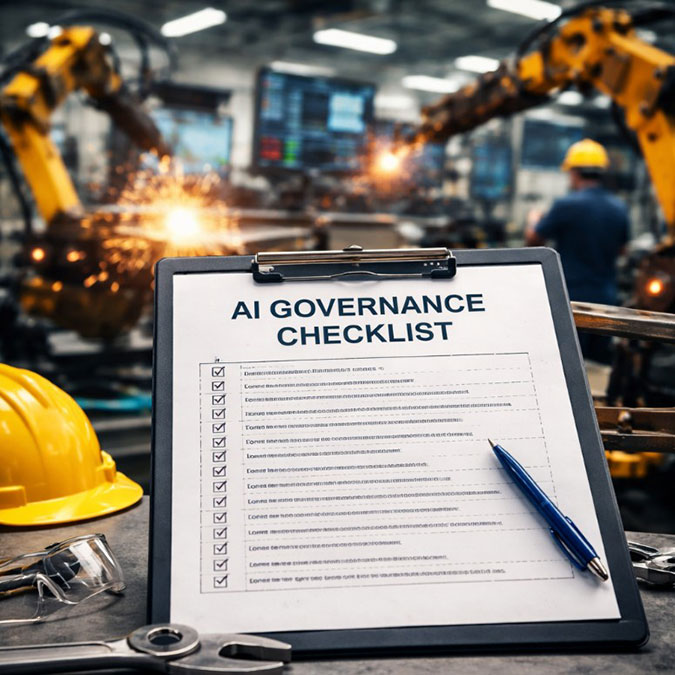
Use this checklist to make sure your company is adopting AI responsibly, securely, and in line with regulations. Print it and review it with your plant manager, IT leader, and executive team.
Section 1: Policy & Documentation
- AI Acceptable Use Policy created and distributed
- Approved AI tools list documented
- Prohibited AI uses clearly defined
- Data classification framework established (public, internal, confidential, restricted)
- AI incident response procedures documented
- Employee acknowledgment of AI policy obtained
AI Acceptable Use Policy
Every manufacturing company using AI needs a written policy. This policy should explain which tools are approved, what types of data can be entered, what data is restricted, who is allowed to use AI, and what happens if someone breaks the rules.
If you operate in Boston, Framingham, or anywhere in southern New England, your policy should also reflect any industry standards you must follow, including NIST or CMMC if you work with defense contracts.
Review and update this policy at least once per quarter.
Approved AI Tools List
Create a clear list of tools your company allows. This may include Microsoft Copilot, ChatGPT Enterprise, or approved automation platforms that connect to your ERP system.
Free public AI tools should not be used for customer specifications, CAD files, supplier pricing, or production data. Block or monitor unapproved tools on your network so employees are not guessing.
Prohibited Uses
Spell out what is not allowed. For example:
- Uploading any sensitive data into free AI platforms
- Sharing passwords or login credentials
- Processing personal information without approval
- Using AI to make regulated decisions without human review
Clarity protects your plant, your contracts, and your reputation.
Section 2: Security & Access Control
- Data Loss Prevention configured for AI tools
- Multi-factor authentication enabled on all AI platforms
- Role-based access controls implemented
- Free-tier AI tools blocked on company networks
- Data retention policies defined for AI-generated content
- Encryption enabled for data at rest and in transit
Data Loss Prevention
Data Loss Prevention, often called DLP, should be configured to block sensitive data from being entered into AI tools. This includes employee records, Social Security numbers, credit card data, controlled technical information, and customer designs.
If your company uses Microsoft 365 or Google Workspace, built-in DLP features are available. They should be turned on and properly configured.
Multi-Factor Authentication and Access Control
Every approved AI platform should require multi-factor authentication. This reduces the risk of unauthorized access.
You should also use role-based access controls. Not every employee needs access to every tool. Limit access based on job function. For example, engineering teams in a Hartford defense manufacturer may need different access than accounting teams in Providence.
Free-Tier AI Tools
Free versions of AI platforms may use your data in ways that do not align with your security needs. On a manufacturing network, that risk is too high. Block free-tier tools and provide secure enterprise alternatives.
Section 3: Training & Awareness
- AI safety training completed for all employees
- Department-specific AI training delivered
- Prompt library created with best practices
- Regular AI Q&A sessions scheduled
- AI champions identified in each department
AI Safety Training
Training is not optional. Every employee should understand what AI is, which tools are approved, what data is safe to use, and how to report concerns.
This applies to office staff, engineers, supervisors, and leadership. Annual refreshers help keep everyone aligned.
Department-Specific Training
Manufacturing departments use AI differently. Engineering may use it for documentation. Operations may use it for production reporting. Sales may use it for proposals. Each department should receive guidance based on real use cases.
Prompt Library
A prompt library is a shared collection of approved AI prompts. For manufacturers, this might include prompts for drafting maintenance checklists, summarizing downtime reports, or preparing supplier communications.
Updating this library regularly ensures your team uses AI effectively and safely.
Section 4: Compliance & Risk Management
- Applicable regulations identified
- Compliance requirements for AI use documented
- Data processing agreements in place with AI vendors
- Privacy impact assessment completed
- Regular compliance audits scheduled
Applicable Regulations
Manufacturers in Massachusetts, Rhode Island, and Connecticut may fall under different regulations depending on the industry. Defense contractors near Hartford may need to follow CMMC. Medical device manufacturers may need to consider HIPAA. Companies serving European customers must understand GDPR.
Identify which rules apply to your company and document how AI usage aligns with them.
Data Processing Agreements
All AI vendors should sign data processing agreements. These agreements should clearly define how your data is used, where it is stored, how long it is retained, and what happens in the event of a breach.
This protects your intellectual property and customer information.
Section 5: Monitoring & Accountability
- AI usage tracking and reporting implemented
- Shadow AI detection processes in place
- Regular policy reviews conducted
- Incident reporting mechanism established
- AI governance owner or committee appointed
Shadow AI Detection
Shadow AI happens when employees use tools that are not approved. This often starts with good intentions. Someone wants to move faster. But without visibility, risk grows.
Monitor network traffic and review SaaS usage reports to identify unapproved tools.
AI Governance Owner
Someone must be responsible for AI governance. This may be your CIO, IT Director, or Compliance Officer. Larger manufacturers in Boston or Worcester may benefit from an AI governance committee that includes IT, operations, HR, and leadership.
Ownership ensures accountability.
How to Use This Checklist
Week 1: Assessment
Review every item on the checklist and mark each as complete, in progress, or not started.
Identify quick wins you can complete immediately.
Flag any items that require budget approval or outside expertise.
Weeks 2 to 4: Build the Foundation
Complete all Policy & Documentation items.
Implement critical Security & Access Control measures such as multi-factor authentication and Data Loss Prevention.
Launch your initial AI safety training for all employees.
Months 2 to 3: Compliance and Monitoring
Address all Compliance & Risk Management requirements.
Implement monitoring systems for AI usage and shadow AI detection.
Conduct your first formal policy compliance review and adjust as needed.
Ongoing: Continuous Improvement
Review the full checklist every quarter.
Update policies as regulations evolve.
Expand training as new AI tools and use cases are introduced.
Share lessons learned and improvements across departments.
What Happens Without Governance?
Manufacturers that skip AI governance face real consequences. Sensitive data can leak through unapproved tools. Defense contracts can be placed at risk. Compliance violations can trigger fines or audits. Clients may lose trust and move to competitors with stronger controls.
In competitive markets like Boston, Providence, and Hartford, reputation matters. One preventable mistake can undo years of hard work.
The Bottom Line
AI governance is not optional for manufacturing companies. It protects your production data, customer information, contracts, and intellectual property. The smartest path forward is to build a strong foundation first. Start with clear policies, secure your systems, train your team, and then expand into monitoring and compliance.
AI can improve your operation. But only when it is managed with discipline.
Need a Hand With Your AI Strategy?
If this checklist revealed gaps in your AI governance, you are not alone. Many manufacturers across southern New England are moving quickly with AI but have not built the policies and safeguards to support it.
We help manufacturing leaders in Boston, Providence, Worcester, Framingham, and Hartford create practical AI governance frameworks that protect their operations while enabling innovation.
If you want a clear and secure AI strategy for your plant, let’s start the conversation.
Click Here to Learn More About Attain Technology’s AI Strategy Services
Frequently Asked Questions
- What is the first step to building an AI governance program in a manufacturing company?
The first step is creating a clear AI Acceptable Use Policy. Before turning on new tools, you need written rules that define which AI platforms are approved, what data can be entered, and what is off limits. This creates structure for your plant, protects production data, and sets expectations for employees. Without policy first, security and compliance efforts will not hold up.
- Can our employees use ChatGPT or other AI tools for production work?
Employees can use AI tools only if the company has approved them and put security controls in place. Free public AI tools should not be used for customer specifications, CAD drawings, supplier pricing, defense-related information, or internal production reports. If you want your team to use AI safely, provide secure enterprise tools, enable multi-factor authentication, and train employees on what data is restricted.
- How does AI governance protect our defense contracts and regulated work?
If your manufacturing company works with defense contracts near Hartford or supports regulated industries in Massachusetts or Rhode Island, you may need to follow standards like CMMC or NIST. AI governance helps ensure controlled technical information is not entered into unapproved systems. By documenting compliance requirements, using secure vendors, and monitoring usage, you reduce the risk of contract violations and failed audits.
- Who inside our manufacturing company should own AI governance?
AI governance should have a clearly assigned owner, such as your CIO, IT Director, or Compliance Officer. Larger manufacturers may benefit from a small governance committee that includes IT, operations, HR, and leadership. The key is accountability. When someone owns the process, policies are updated, training happens on schedule, and security controls are enforced.
- How often should we review and update our AI governance checklist?
Manufacturing companies should review their AI governance checklist at least once per quarter. Technology changes quickly, and regulations evolve. Quarterly reviews help ensure your policies, training, monitoring tools, and compliance documentation stay aligned with how AI is actually being used in your plant. Regular reviews also help you catch gaps before they turn into security or compliance problems.
