

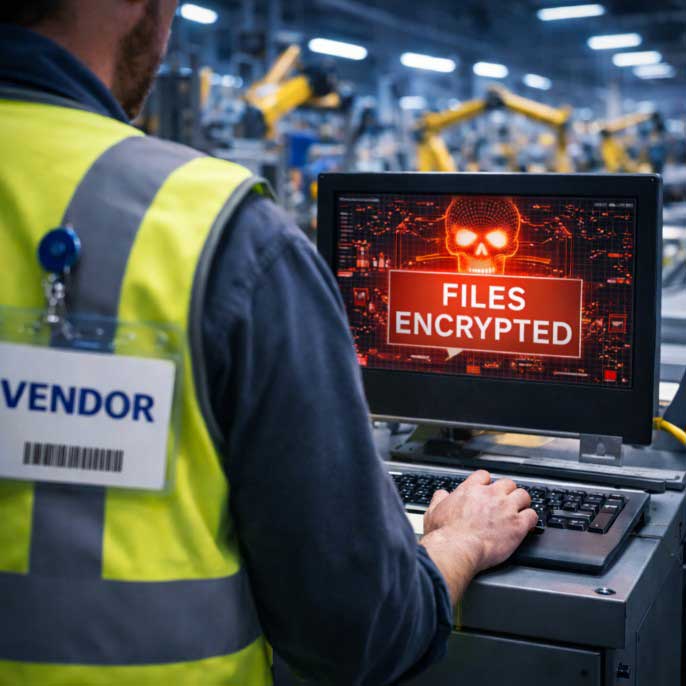
Manufacturing leaders spend a lot of time thinking about machines, people, and production schedules… but what about your vendors?
If you run a plant in Boston, Providence, Worcester, Framingham, or Hartford, uptime matters every day. One late shipment or one stopped line can cause big problems fast.
But there is a risk many manufacturing leaders do not see right away. It does not come from an employee or a broken machine. It comes from the vendors who support your operation.
This risk is growing quickly. According to the 2025 Verizon Data Breach Investigations Report, third-party breaches doubled and now account for 30 percent of all breaches. That means nearly one out of every three incidents starts with a vendor, supplier, or outside partner.
For manufacturers, this is not just a data issue. It is a shop floor issue. When vendor access goes wrong, production, quality, and delivery are often the first things affected.
What Vendor Risk Really Looks Like in Manufacturing
Vendor risk in manufacturing is often misunderstood. Many leaders think it only applies to cybersecurity or IT systems. In reality, vendor risk shows up wherever a third party touches your operation.
This includes equipment vendors, machine builders, software providers, ERP partners, maintenance contractors, and remote support teams. If a vendor can log into your systems, connect to your network, or access production data, they are part of your risk.
In a manufacturing environment, that risk does not stay on a screen. It reaches the shop floor. It can slow production, affect quality, or stop a line completely.
How Vendors End Up With Access to Your Shop Floor
Vendor access usually starts for good reasons. A technician needs to troubleshoot a machine. A software provider needs to apply an update. A vendor needs remote access to keep production running.
Over time, this access builds up. Temporary access is not removed. Old logins still work. Remote tools stay connected. Cloud systems keep pulling production data. Very few manufacturers stop to review all vendor access in one place.
Most of this access is added for speed and convenience. Long-term control is often an afterthought.
Why Vendor Risk Hits Manufacturing Harder
Manufacturing systems are built to run all the time. Many shop floor systems were designed years ago with uptime as the top priority. Security was not part of the original design.
When something goes wrong, the impact is immediate. A vendor issue can stop a production line. It can delay orders. It can create quality problems that take days to fix.
For manufacturers in New England, downtime is expensive and visible. Customers notice. Schedules slip. Trust is tested. That is why vendor risk is more than a technical issue. It is a business risk.
Common Vendor Risks We See on Manufacturing Shop Floors
These risks show up often in manufacturing environments across Boston, Worcester, Providence, Framingham, and Hartford:
- Vendors have access to more systems than they need
- Vendor access is never reviewed after it is granted
- Vendors use weak passwords or no multi-factor authentication
- Vendors connect from unsecured networks or personal devices
- Vendors experience a breach and do not report it right away
Most of the time, there is no bad intent. The problem is a lack of visibility and ownership.
What Happens When a Vendor Causes a Problem
When a vendor issue turns into an incident, the effects spread quickly. Production slows or stops. Quality issues appear. Orders are delayed. Customers start asking questions.
Even if the vendor caused the issue, the responsibility still falls on the manufacturer. Customers and partners hold you accountable. From their point of view, it is your operation that failed.
This is why vendor risk management matters to manufacturing leaders, not just IT teams.
Why This Risk Often Goes Unnoticed
Vendor risk grows quietly. Access is added over months and years. Different teams assume someone else is tracking it. Operations assumes IT owns it. IT assumes operations approved it.
Vendors are trusted partners, not seen as a threat. This creates a blind spot. It is not neglect. It is a gap that forms over time.
Questions Manufacturing Leaders Should Ask
These questions help bring vendor risk into focus:
- Who has access to our manufacturing systems today
- Why do they have that access
- What systems and machines can vendors reach
- How do we know when vendors connect remotely
- What happens if one of our vendors is breached
If these answers are unclear, there is risk on the shop floor.
What You Can Do To Limit This Risk
Manufacturers do not need to shut things down to reduce vendor risk. Practical steps can improve control while keeping production moving:
- Create a full list of vendor access across systems
- Limit vendor access to only what is needed
- Use multi-factor authentication and time-limited access
- Separate vendor access from core production systems
- Review vendor access on a regular schedule
Why This Matters for New England Manufacturers
Manufacturers in southern New England operate in dense vendor ecosystems. Plants often run a mix of legacy equipment and modern systems. Delivery timelines are tight. Customers expect reliability.
In cities like Boston, Providence, Worcester, Framingham, and Hartford, one disruption can affect multiple partners and customers. Managing vendor risk is part of protecting your reputation and your ability to deliver.
How Attain Technology Supports Manufacturing Leaders
Vendor risk management works best when it is built around how manufacturing actually operates. Attain Technology works with manufacturing leaders across New England to identify vendor access risks and reduce exposure on the shop floor.
Our focus is simple. Protect production. Reduce downtime. Give leaders clear visibility into who has access and why.
Want to see where your manufacturing business is at risk?
If you have not reviewed vendor access in the past year, now is the right time. Let’s have a conversation about your cybersecurity and what you can do to protect what you’ve built.
Get in touch with us here:
Schedule a Discovery Call with Attain Technology
FAQ
1) What is third-party vendor risk in manufacturing?
Third-party vendor risk is the risk that a vendor, supplier, or contractor could cause a problem in your operation. This can happen when they have access to your manufacturing systems, your network, or your shop floor equipment.
2) Why are third-party vendors a hidden risk on the shop floor?
They are a hidden risk because vendor access often grows over time and is not reviewed. Many manufacturers do not have a clear list of who can log in, connect remotely, or reach key systems and machines.
3) What are common vendor access risks manufacturers should watch for?
Common risks include vendors having more access than they need, vendor access that is never reviewed, weak passwords, no multi-factor authentication, and remote access from unsecured networks or personal devices.
4) How can a vendor-related incident affect production?
A vendor-related incident can slow or stop a production line. It can also cause quality problems, delay orders, and create downtime that hurts revenue and customer trust.
5) What is the first step to reducing vendor risk without slowing production?
The first step is to create a full list of vendor access across systems and machines. Once you know who has access and why, you can limit access and add better controls like multi-factor authentication and time-limited access.
Download the Downtime Tip Sheet
