

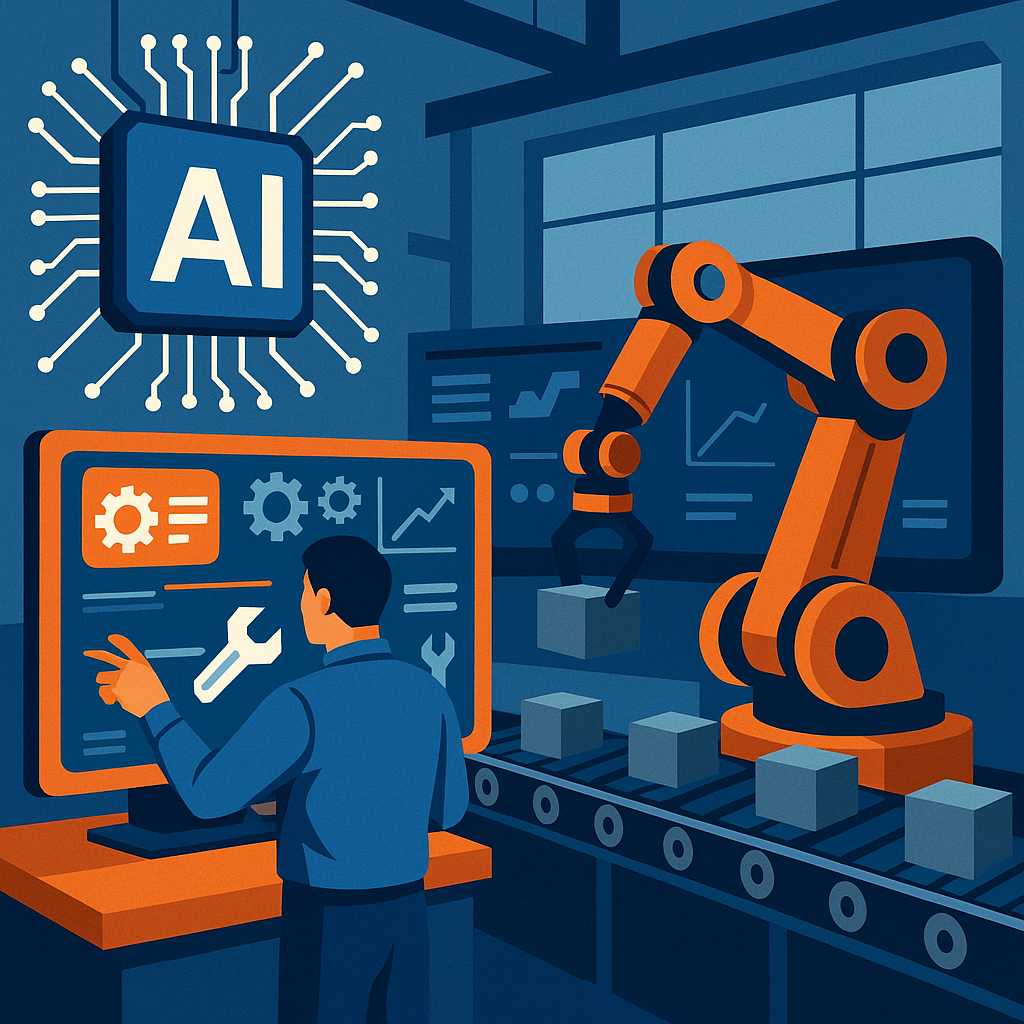
Picture a manufacturing facility in Boston or Providence where machines aren’t just running — they’re learning…
Data from every sensor, every process, flows into systems that continually optimize production. Systems that don’t just follow instructions but adapt and improve themselves.
For manufacturing leaders across New England, this is not a distant vision — it’s the frontier heading into 2026. As you navigate pressures from labor shortages, energy costs, and global supply-chain uncertainty, your factory’s ability to harness AI will increasingly determine whether you lead or lag.
Elevating Efficiency with Predictive Intelligence
Across U.S. manufacturing, unplanned equipment downtime remains one of the biggest hidden cost drains. According to a 2025 industry-wide study, firms implementing predictive maintenance reported reductions in unplanned machine downtime by up to 50%. Sockeye Technologies
In practice, for a plant manager in Hartford or a production director in Providence, that means fewer emergency stops, less frantic parts sourcing, and more consistent output. In the real world this provides breathing room for planning rather than firefighting.
From Automation to Autonomous Systems
You’re already familiar with robots doing repetitive tasks. What’s coming by 2026 is the era of autonomous systems — machines that learn from production data and optimize without needing explicit reprogramming.
For example: a machining center in Massachusetts adjusts its pathing mid-run to reduce material waste; a vision system in Connecticut flags subtle defects and recalibrates inspection parameters.
While exact industry-wide benchmarks for this level of autonomy are still emerging, the momentum around AI adoption in manufacturing is clear: the global AI-in-manufacturing market was valued at about USD 4.2 billion in 2024 and is projected to grow rapidly. Global Market Insights.
For New England manufacturers, integrating these autonomous capabilities means not just catching up — but differentiating.
Re-Imagining the Workforce
In Boston’s manufacturing corridors, the labor challenge is real: skilled machinists are retiring, the next generation is smaller, and global competition means talent matters.
Instead of asking “Will AI replace humans?”, the better question is: “How will AI redefine human roles?”
By 2026 you’re likely to see more “AI copilots” on the shop floor: technicians paired with augmented-analytics dashboards, operators assisted by real-time decision prompts. It’s about elevating human capability, not erasing it.
Sustainability Through Smart Manufacturing
Manufacturers in Rhode Island and Connecticut are under increasing pressure to reduce energy use and embodied carbon. AI can play a significant role here.
Academic research shows that AI adoption in manufacturing industries correlates with measurable reductions in energy intensity.
In practical terms, by 2026 you might see your production scheduler automatically shifting high-load processes to off-peak hours, or your HVAC and lighting systems dynamically adapting based on equipment usage. That aligns productivity with sustainability — a win-win.
The Regional Edge: Localized AI Ecosystems
You compete globally, but you operate regionally. One of the standout opportunities for New England manufacturers in 2026 is building connected regional ecosystems — not simply global supply chains.
Consider this: your Hartford plant is digitally connected with a supplier in Worcester and a parts warehouse in Providence. AI predicts material demand, schedules deliveries just-in-time, and dynamically adjusts when disruption hits.
That regional digital network offers shorter lead-times, reduced freight costs, and faster reaction to change — giving you an edge compared to manufacturers dependent on far-flung supply chains.
Preparing Your Factory for 2026
So what should you do now to stay ahead?
- Begin a data audit. What systems capture production-floor data today? Are you monitoring vibration, temperature, cycle times, quality rejects?
- Pilot a focused AI use case. For instance: select one production line in your Boston or Providence facility and implement an AI-driven predictive maintenance or energy optimization module.
- Choose the right partner. Implementing AI in manufacturing is not a generic IT project. You’ll benefit from a partner who understands both manufacturing processes and AI technology.
- Plan for human plus machine. Start upskilling your workforce now so that technicians, operators and supervisors can work fluidly with AI-augmented systems by 2026.
By acting now, you’ll position your operation in New England to be one of the leaders — not the followers — of the AI-manufacturing wave.
What You Do Right Now…
If your factory hasn’t laid a path for AI readiness yet, start today. Schedule a free Manufacturing AI Workshop with Attain Technology to uncover the one or two AI-driven capabilities that will deliver the highest return by 2026 in your Boston, Providence or Hartford facility.
Spots are limited, sign up today at this link and start seeing how AI can boost your manufacturing business today: Save Your Spot
Why Choose Attain Technology
At Attain Technology, we’ve supported New England’s construction and manufacturing leaders for nearly 20 years. Our proactive IT management, transparent communication and 24/7 human support mean your systems work as hard as you do. From Boston to Providence to Hartford, we help manufacturers modernize with AI-driven tools that boost uptime, security and productivity. If you’re ready for stress-free, future-focused IT, we’d love to talk.
FAQ:
1. How is AI transforming manufacturing in New England heading into 2026?
AI is helping manufacturers across Massachusetts, Rhode Island, and Connecticut move from automation to autonomy. Systems powered by artificial intelligence now analyze real-time production data, reduce downtime, optimize material use, and support predictive maintenance — giving regional manufacturers a competitive edge in efficiency and output.
2. What are the first steps manufacturers can take to adopt AI technology?
Start by conducting a data audit to identify where production data is being collected and how it’s being used. Next, pilot a focused AI project — like predictive maintenance or energy optimization — on one production line. Finally, work with a technology partner that understands both manufacturing operations and AI integration.
3. How will AI impact manufacturing jobs in 2026?
AI will not replace people — it will enhance their abilities. Manufacturers are already seeing the rise of “AI copilots,” where operators and technicians work alongside smart systems that provide real-time insights and recommendations. This shift allows workers to focus on higher-value tasks while improving overall plant performance.
4. Why should manufacturers in Boston, Providence, and Hartford act now?
By implementing AI now, manufacturers can start gathering the data and experience needed to compete in 2026’s increasingly intelligent production environment. Early adopters in Boston, Providence, and Hartford are already improving uptime, reducing costs, and creating more sustainable and resilient local supply networks.
