
Manufacturing leaders across New England are hearing more about artificial intelligence every year…
The pressure to act is growing. According to Rockwell Automation’s State of Smart Manufacturing Report, 95 percent of manufacturing companies plan to invest in AI or machine learning within the next five years. This includes manufacturers operating in Boston, Providence, Worcester, Framingham, and Hartford. (Source: Rockwell Automation)
Why This Matters Now
95%… Think about that. Almost every manufacturer is planning to hop on this train.
If AI is helping your competitors do that now, imagine what AI can help them do 5 years from now. If you’re not on this train early, you may not be able to get on the train at all.
Still, many manufacturing leaders feel stuck. They know AI is important, but they are unsure where to start. They worry about disrupting production, overwhelming their teams, or spending money on the wrong tools. A common question is how manufacturers should start using AI without disrupting production.
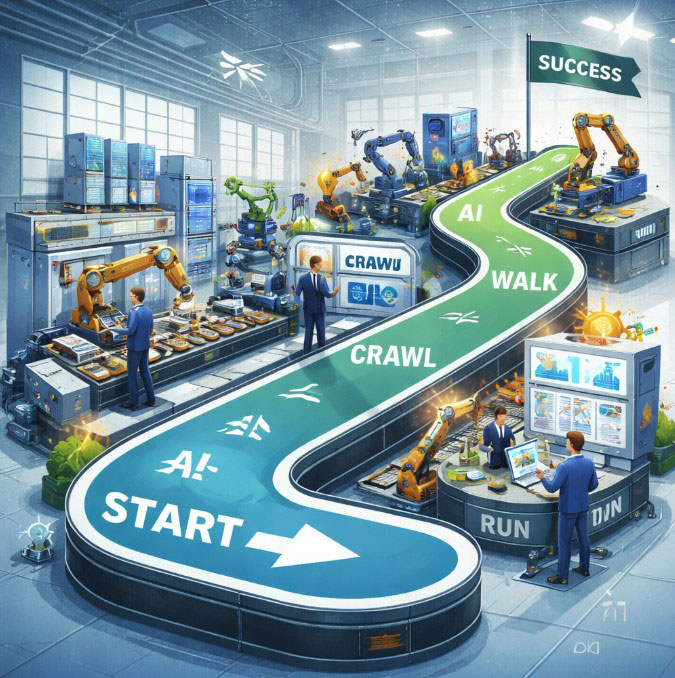
That is why having a clear AI roadmap matters. This blog walks through how to make an AI roadmap for your manufacturing business from start to finish using a simple Crawl, Walk, Run approach. It is designed for real manufacturing environments, not tech labs, and it works especially well for small and mid-size manufacturers in Southern New England.
Why Manufacturing Leaders Need an AI Roadmap
AI in manufacturing should not feel risky or confusing. When done right, it helps reduce downtime, improve quality, and support better decisions on the plant floor. Without a roadmap, AI efforts often stall or fail because they start too big or lack clear goals.
A strong AI roadmap helps you:
- Focus on real business problems
- Start small with less risk
- Build trust with your team
- Measure results clearly
- Scale only after value is proven
This is especially important for manufacturers in Massachusetts, Rhode Island, and Connecticut where many facilities run lean teams and rely on a mix of older and newer systems. This AI roadmap is for manufacturing businesses leaders who want to seamlessly move from planning to execution.
CRAWL: Start Small and Build Confidence
The crawl stage is about learning safely. Your goal is not to transform your entire operation. Your goal is to prove that AI can help with one real problem.
Start With One Clear Problem
The best AI projects start with a problem that already causes frustration. Common starting points include:
- Too much scrap or rework
- Unplanned downtime
- Missed production schedules
- Inventory shortages or excess
If the problem can be measured, it is a good candidate. If it cannot be measured yet, start by tracking it.
AI works best when it has a clear purpose.
Use the Data You Already Collect
Most manufacturing businesses already have useful data. It often lives in:
- ERP systems
- MES systems
- Maintenance records
- Quality reports
- Spreadsheets
AI uses past data to find patterns. It does not guess or replace experience. The better your data, the better the insight. You do not need perfect data to begin. You just need enough to test and learn.
Choose a Simple AI Use Case
Some AI use cases are easier to start with than others. Strong first options include:
- AI powered visual inspection
- Predictive maintenance
- Basic demand forecasting
- Process monitoring to catch trends early
These use cases often deliver value quickly and do not require major system changes.
Run a Short Pilot
A pilot is a controlled test. It should last 30 to 90 days and follow simple rules:
- Focus on one line or one process
- Set one clear goal
- Assign one owner
- Review progress weekly
For example, reduce scrap on a single line or identify early warning signs of machine failure. Pilots reduce risk and build confidence.
WALK: Expand What Works and Prepare Your Team
Once the pilot shows results, the next step is to turn success into something repeatable.
Build a Small and Focused Team
AI projects work best with clear ownership. A typical team includes:
- One operations leader responsible for results
- One process expert who understands the work
- IT support to manage data access and security
- A trusted AI or manufacturing software partner
Clear roles keep projects moving and prevent confusion.
Train Your Team in a Practical Way
Training should fit the reality of the plant floor. The most effective training is:
- Short and focused
- Based on real plant examples
- Easy to repeat across shifts
- Clear about why the tool matters
AI should feel like a support tool, not a replacement for skilled workers. When teams understand how AI helps them do their jobs better, adoption improves.
Choose Software That Fits Your Plant
Not all AI software is built for manufacturing. When evaluating options, look for solutions that:
- Work with your existing ERP, MES, or maintenance systems
- Deliver value quickly
- Use clear and simple dashboards
- Offer strong training and support
- Have real manufacturing references
Be cautious of tools that require long setup times or major system replacements. In many manufacturing environments, simpler tools perform better.
RUN: Scale AI Across the Business
After success in the walk phase, you are ready to scale AI across more of your operation.
Standardize What Works
Document what made the pilot successful. Create simple standard work and make AI part of daily routines. When AI becomes part of normal operations, it delivers consistent value.
Scale Gradually
Move from one line to the next using the same playbook. Manufacturers in Worcester, Framingham, and Hartford often see better long term results when they scale steadily rather than rushing.
Consistency matters more than speed.
Keep Improving Over Time
AI systems need regular attention. Strong habits include:
- Monthly reviews of results
- Ongoing data quality checks
- Updates when processes change
- Continued leadership involvement
AI improves when your processes improve.
Your Next Step
If you are unsure how to make an AI roadmap for your manufacturing business, start with a personal AI workshop from Attain Technology.
We’ll work with you and your team to find where AI fits in your business, how you can implement it, and how to get the most out of AI tools.
We run a limited number of these workshops at a time, visit the link here to save your spot.
Sign Up For Attain Technology’s Manufacturing AI Workshop
Why Choose Attain Technology
At Attain Technology, we have supported manufacturing leaders across New England for nearly 20 years. We understand plant operations, mixed technology environments, and the need to keep production running without disruption. Our proactive IT management, clear communication, and human support help manufacturers adopt AI and advanced technology with confidence. If you are ready to build an AI roadmap that fits your business, we would be glad to talk.
FAQ
What is an AI roadmap in manufacturing?
An AI roadmap is a step by step plan that shows how a manufacturing business can adopt artificial intelligence over time. It helps leaders start small, reduce risk, and scale AI only after it proves value.
Where should a manufacturing company start with AI?
Most manufacturers should start with one clear business problem such as downtime, scrap, or scheduling issues. A small pilot using existing data is often the best first step.
Do small and mid size manufacturers really benefit from AI?
Yes. Many small and mid size manufacturers see strong results by using AI for focused use cases like predictive maintenance, quality inspection, and demand forecasting.
How long does it take to see results from AI in manufacturing?
Many AI pilots show measurable results within 30 to 90 days when the scope is clear and the goal is well defined.
Will AI replace workers on the manufacturing floor?
In most cases, AI supports skilled workers by helping them spot issues earlier and make better decisions. It is designed to assist people, not replace them
